Living History Museum · Est. 1787
Destrehan tells its history by name — the family whose portraits hang in the main house, and the enslaved men and women who built it and kept it running.
"You'll be introduced by name, not just to the people whose portraits hang in this historic home, but to the enslaved men and women who built this plantation and made it thrive." — from the introduction every guided tour opens with
Landowner Robin de Logny commissions the house in 1787; Charles Paquet, an enslaved master builder, designs and constructs it by 1790. De Logny paid Paquet in rice, corn, livestock, and cash — and Paquet gained his freedom during the build. Jean Noel Destrehan, who needed roughly 100 enslaved workers to run the sugar fields, becomes the plantation's namesake owner in the years that follow.
The largest slave revolt in U.S. history, led by Charles Deslondes, moves downriver toward New Orleans before being put down. Jean Noel Destrehan presided over one of the three resulting trials, held at Destrehan, where 67 enslaved people were tried. The Miller-Haydel Museum's exhibit — with artwork by folk artist Lorraine Gendron — tells this history in detail.
Jean Noel Destrehan dies in 1823, splitting the estate among his children. In 1839, Pierre Rost — married to Destrehan's daughter Louise Odile — buys the plantation outright, remodels it in the Greek Revival style, and grows it into the largest sugar producer in St. Charles Parish.
Union forces seized the plantation in 1862; formerly enslaved people and refugees live and work there under the Freedmen's Bureau — one of the earliest such colonies in the South — until it's returned to the Rost family in 1867.
Emile Rost sells the plantation out of the family in 1910; by 1914 it belongs to the Mexican Oil Company (later Amoco), which builds a refinery and company town on the grounds. When the refinery closes in 1958, the house is abandoned and left to vandals drawn by a local legend of Jean Lafitte's buried treasure.
Local citizens form the Society in 1968; it's chartered by the State of Louisiana in January 1969. Amoco donates the house and roughly four acres to the Society in December 1971, and restoration begins.
Guided tours, exhibits, and education programs keep the full history of the site, family and enslaved community both, in view.
Jean Noel Destrehan and his descendants ran the plantation from 1787 until it was sold in 1910. The main house still holds the family's portraits and personal documents, including the Jefferson Room's letter signed by Thomas Jefferson and James Madison.
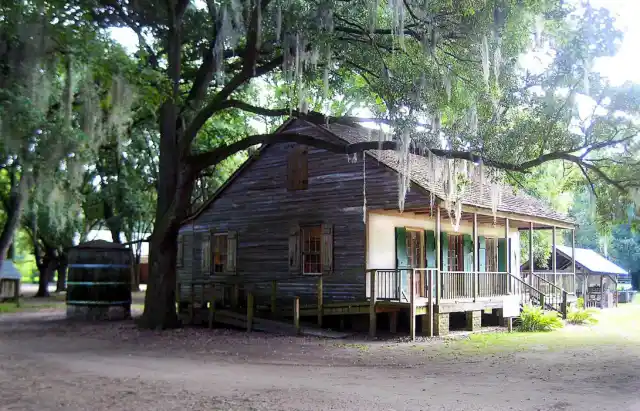
Every guided tour includes an inventory naming the men and women enslaved at Destrehan, and a walk through an original enslaved cabin. Their labor built and ran the plantation for well over a century — under the 1724 Code Noir, with many brought originally from the Senegambia region (including Bambara and Mandingo peoples). Robin de Logny held about 59 enslaved workers for indigo production; under Jean Noel Destrehan's sugar operation that grew toward 100, and by the Civil War over 200 enslaved people lived on the plantation. Slavery ended here with the 13th Amendment's ratification in December 1865.
Primary-source documentation the museum makes available to researchers and visitors, carried over directly from the current site's archive.
Enslaved people included in the 1782 sale of the plantation by Guillaume Guignan to Robert de Logny.
Inventory of enslaved people in the estate of Antoine Robert de Logny.
Enslaved people purchased by Stephen Henderson from the estate of Celeste Robin de Logny, widow of Jean Destrehan.
Enslaved people included in the succession of Stephen Henderson.
1840–1860 U.S. Census data is also on file, documenting roughly 210 enslaved people at Destrehan by 1850. View the full registry on the current site →
An authentic document signed by Thomas Jefferson and James Madison.
Original artifacts and documents from the family's later generations.
Two exhibits: the 1811 German Coast Uprising, and the Rost Home Colony.
A sugar and textile museum housed in a working plantation barn.
Original cabins from Helvetia Plantation, donated by Entergy after Hurricane Betsy destroyed the site in 1965. One side depicts enslaved living quarters; the other shows the cooper workshop of Essex, an enslaved barrel maker on the plantation in the early 1800s.
Rebuilt on its original footprint, showing how meal preparation worked for plantation families.
An original well beside the 1826 laundry building, illustrating the labor-intensive wash-day process of the 19th century.
Since 1968, the River Road Historical Society has preserved the historic buildings of River Road and used Destrehan Plantation as a learning environment — funding new exhibits, education programs, and public events through tour proceeds and donations.
A guided tour covers the main house, the enslaved cabin, and both museum exhibits — with a daily historical demonstration on the grounds.